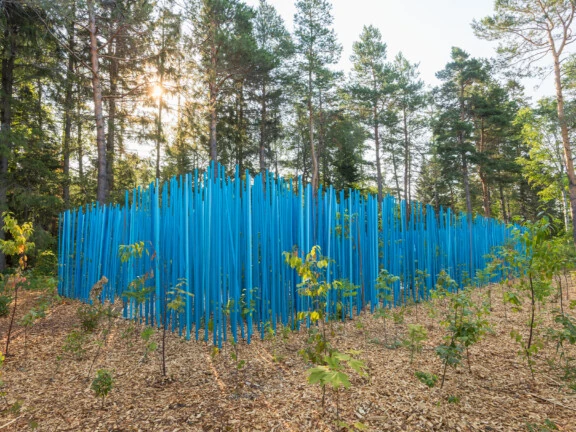
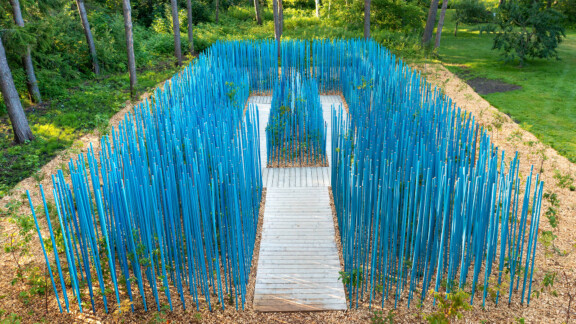
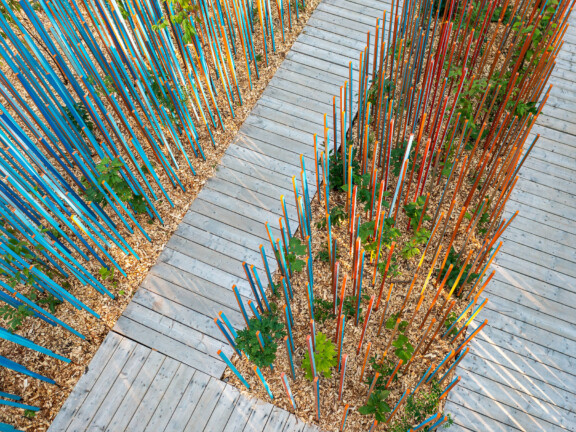
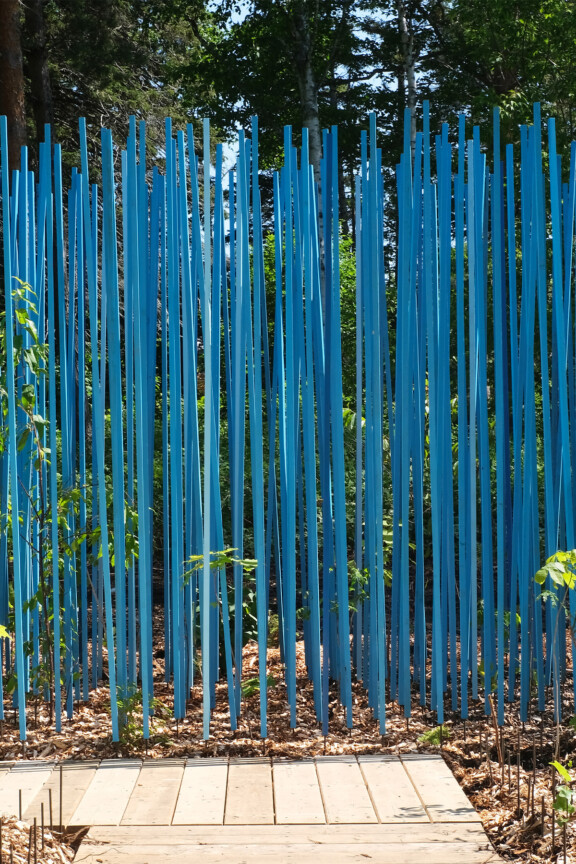
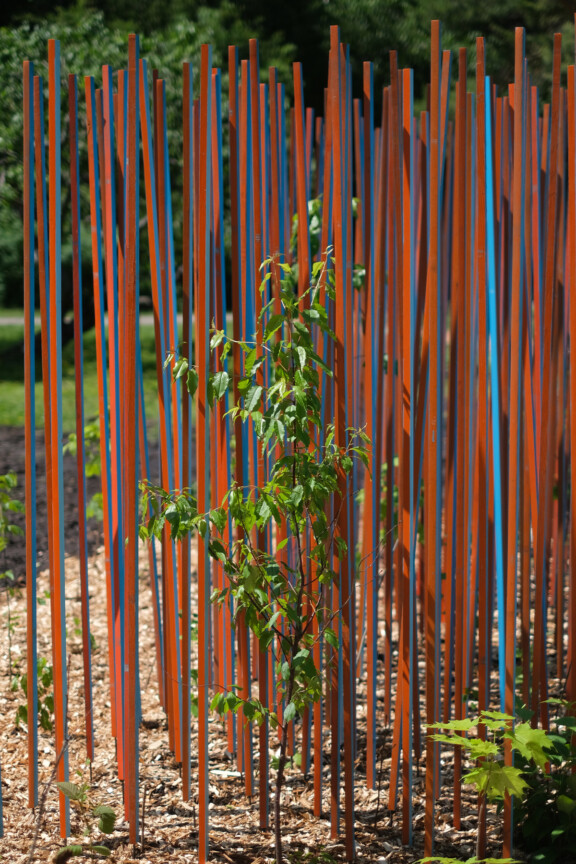
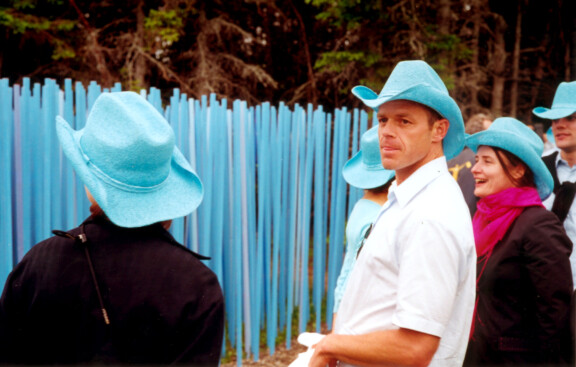
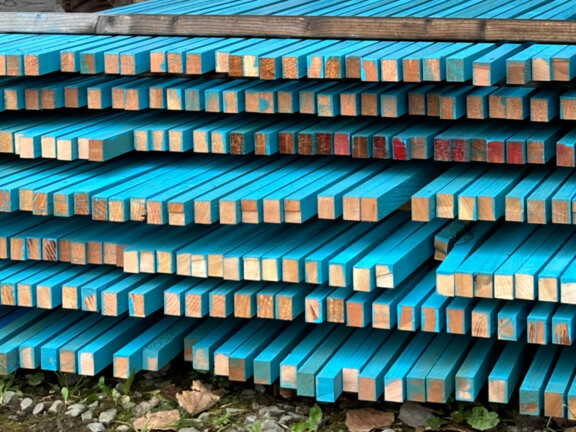
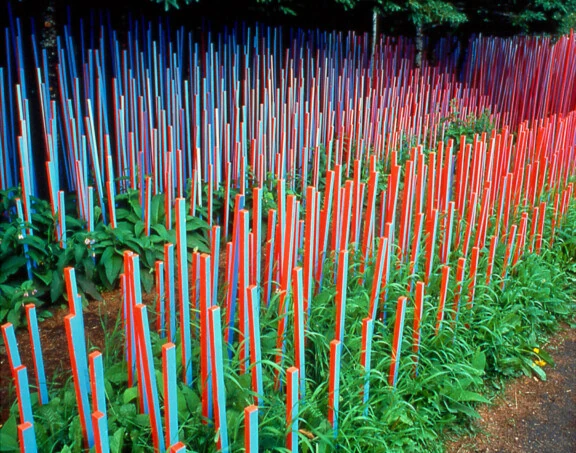
Blue Stick Garden – conceived in 2000 by CCxA for the first edition of the International Garden Festival at the Metis Reford Gardens – becomes the Blue Stick Forest, at Metis Reford Gardens, after 25 years of touring Canada and England. The Forest showcases the iconic Blue Stick Garden, a pixelated metamorphosis of the famous Himalayan blue poppy carefully acclimatised and cultivated in Metis by Elsie Reford, within a new ecosystem: a micro-forest composed of plant species from warmer climatic zones that winds through and envelops the 2,500 blue and orange sticks.
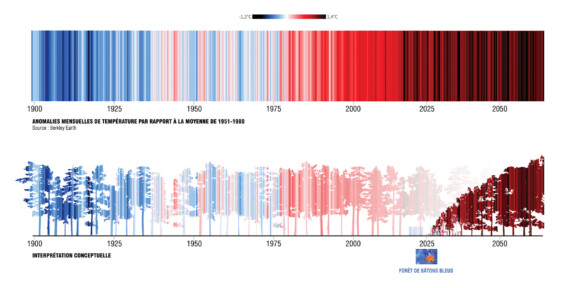
Two temporalities thus juxtapose each other: that of the garden and the spectacular flowering of the blue poppy, evoked by the startling colour change of the sticks, and that of the rhythm of forest ecosystems, called upon to change and adapt in the face of climate change. Together they compose a singular hybridization between nature and culture.
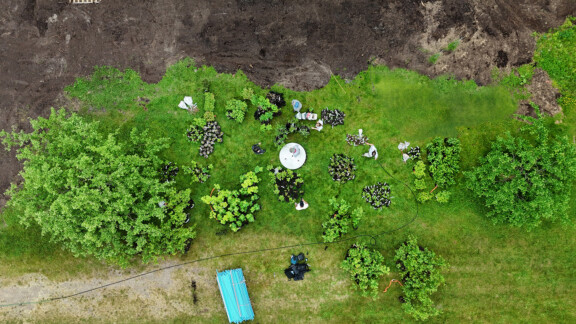
Inspired by the innovative microforests planting methods developed by botanist A. Miyawaki, the Forest consists of 1,800 densely planted specimen trees, shrubs and perennials, eager to symbiotically enhance their properties and grow at an astonishing rate.
Building on the recent observation that North American hardiness zones are retreating (at a rate of a quarter to half a zone per decade) and the principle of assisted migration, today’s native plant families are joined by those of tomorrow (sugar maple, oak, honeysuckle, etc.), capturing the genealogical portrait of a new forest already underway in the Lower St. Lawrence.
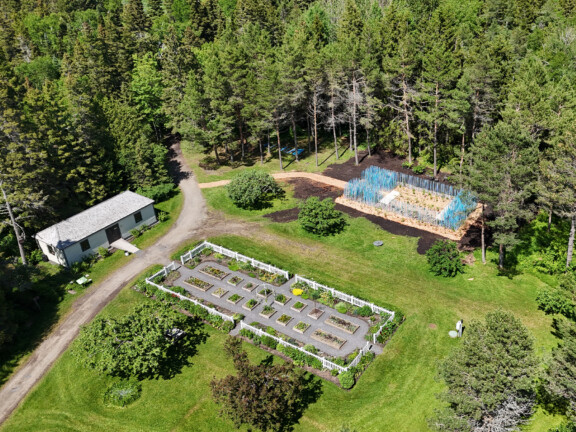
Situated beside Elsie’s vegetable patch – Elsie Reford’s first place of horticultural exploration and experimentation – the Blue Stick Forest is a tribute to CCxA founder Claude Cormier, and his practice based on innovation, experimentation, learning and Serious Fun (the title of the 2021 monograph dedicated to his career and the firm’s work).
The experimental aspect of Blue Stick Forest commemorates the dedication, passion and patience of the avant-garde visionaries who contributed to the growth of the Metis Reford Gardens and to the evolution of the practice of landscape architecture, as well as establishing itself as an act of commitment of new generations towards the future.